
The Opportunity: Turn Random Referrals Into a Predictable Growth System
Throughout my business career, I've learned that some of the best opportunities come through relationships. A trusted introduction can open doors that might otherwise take months of prospecting, marketing, and follow-up to open.
Yet many business owners, sales professionals, and entrepreneurs approach referrals without a consistent strategy.
They depend on someone remembering them, thinking about them at the right moment, or making an introduction when an opportunity happens to come along.
The consequences are predictable:
Inconsistent referrals: Opportunities arrive randomly, making it difficult to forecast new business.
Weak relationships: Referral partners become transactional contacts instead of trusted business allies.
Poor-quality introductions: Partners may refer people who don't match your ideal client profile.
Limited differentiation: Prospective partners don't understand what makes you or your business unique.
Missed opportunities: Without consistent communication and follow-up, potential referrals fall through the cracks.
Low relationship equity: Partners have little motivation to actively recommend you.
My background in professional football taught me the importance of having a playbook. Great teams recruit the right players, develop their skills, execute consistent plays, and make adjustments as they learn what works.
The same principles apply to building a successful referral partnership network.
I've developed seven plays that can help you recruit better partners, establish credibility, deepen relationships, and create a consistent process for generating more qualified opportunities.
You don't need to execute every play immediately. Start with one or two, validate what works, master the process, and build from there.
ACTION STEP: Evaluate your current referral process. Identify where you're relying on random opportunities instead of a consistent system. Choose one or two areas where improvement could create the greatest immediate impact.
PLAY 1: Prospecting for Partners
Recruit the Right Players and Build Your Referral Partner Depth Chart
In football, recruiting matters. You can have the best playbook in the world, but if you don't have the right players running the plays, you're going to struggle.
Referral partnerships work the same way.
The goal is to identify people who already have trusted relationships with the customers you want to serve.
Start by identifying the professional categories most likely to have access to your ideal clients. Depending on your industry, these might include accountants, attorneys, financial advisors, business coaches, consultants, insurance professionals, or other complementary service providers.
You can use AI to brainstorm these categories by asking which professionals most frequently serve your ideal client profile.
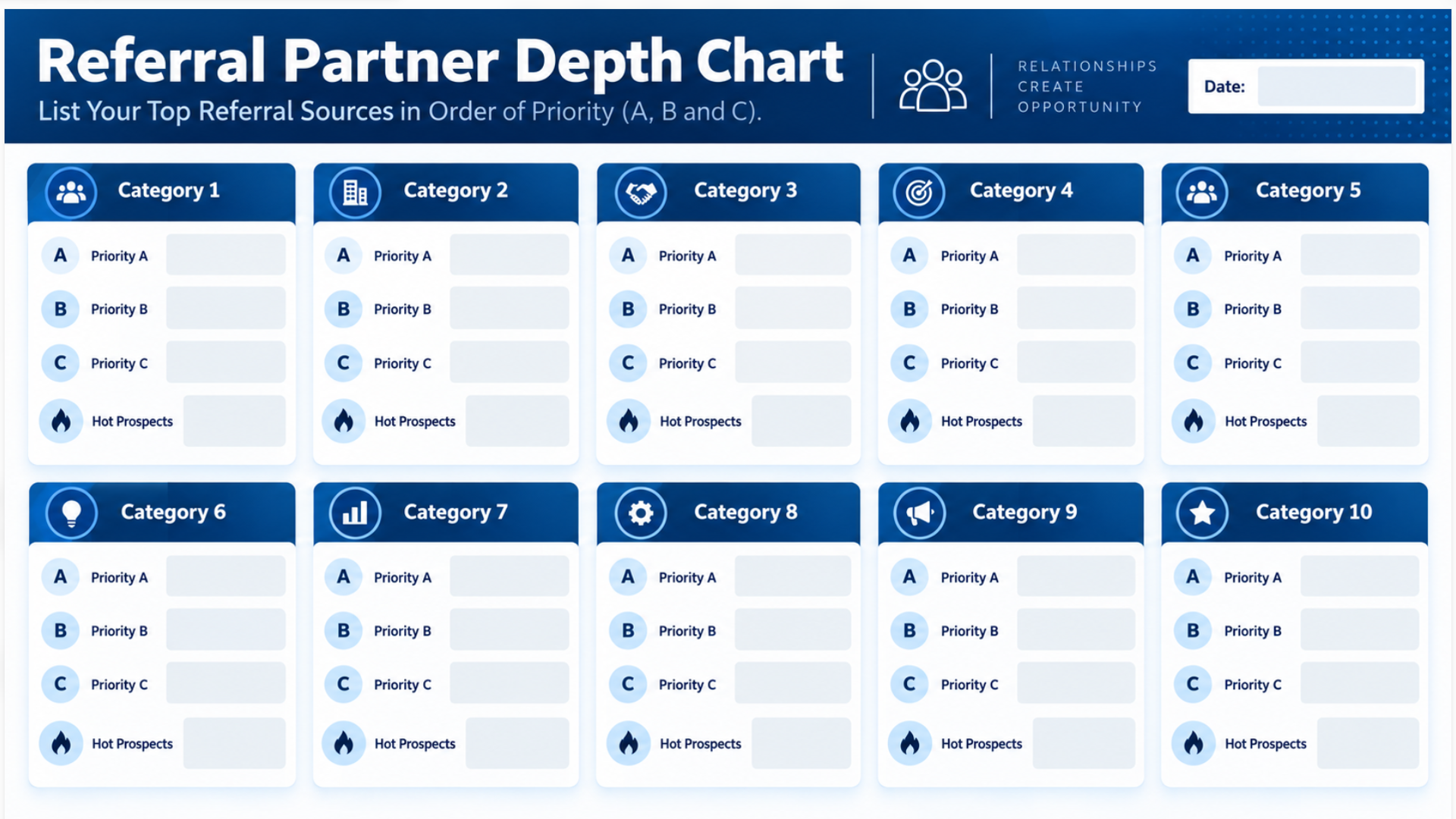
From there, build what I call a Referral Partner Depth Chart.
Just like a football team needs starters and backups, your business needs multiple qualified referral partner prospects in each important category.
I recommend identifying at least three potential partners in each category, prioritizing the strongest opportunities, and developing deeper relationships with your best prospects.
Four Types of Referral Partners
Not every referral partner provides the same return on your time and energy.
Partner TypeCharacteristicsRecommended ApproachHigh Value / Low MaintenanceGenerates quality referrals with relatively little supportPrioritize and replicateHigh Value / High MaintenanceProduces opportunities but requires substantial attentionEvaluate the return on timeLow Value / Low MaintenanceProvides occasional opportunities with little effortMaintain selectivelyLow Value / High MaintenanceRequires significant attention with limited resultsReduce investment or replace
Your objective is to recruit more high-value, low-maintenance partners while maintaining a strong bench of potential replacements.
Consider the potential of having ten strong referral partners, each providing just one qualified referral per month.
That's ten additional opportunities each month.
If each provides two or three, the opportunity multiplies.
Use Your Existing Network Before Starting From Scratch
One of the best places to find prospective referral partners is your existing LinkedIn network.
You can export your LinkedIn connections into a spreadsheet, organize them by professional title or industry, and use AI to identify potential partners who match your target categories.
In my own example, I exported approximately 6,000 LinkedIn connections and used AI to identify more than 2,100 people matching selected professional categories.
That gave me a much more manageable group of people to evaluate and prioritize.
You can also use LinkedIn search tools, Sales Navigator, and premium B2B data to identify additional prospects.
The key is having an organized roster that identifies your top priorities and the next people you want to recruit.
ACTION STEP: Identify your ten most valuable referral partner categories and build a depth chart with at least three potential partners in each category. Review your LinkedIn connections, existing relationships, and professional network to identify your strongest candidates.
PLAY 2: Approach Prospective Partners With Confidence and Value
Earn the First Appointment by Giving People a Reason to Meet
One of my favorite principles is:
"If you need them, you can't lead them."
When approaching prospective referral partners, your positioning matters.
If your opening message communicates that you need their referrals, you're putting yourself in a weak position.
Instead, approach the relationship from the perspective of someone who has value to offer and wants to explore whether there's an opportunity to help each other.
One of my favorite prospecting questions is:
"Who's the best financial advisor, accountant, business coach, or other professional you know in our community?"
That simple question often generates high-quality recommendations.
When I contact the recommended person, I can say:
"I recently asked John Jones who the best financial advisor was in our community, and he gave me your name. I'd love to learn more about what you do and see if there might be an opportunity for us to work together."
The introduction immediately creates a level of credibility.
Lead With Problems You Can Help Solve
Before reaching out, ask yourself:
What problems does this potential partner deal with? What opportunities are they missing? What outcomes are they trying to achieve?
Your message should connect your expertise to something they actually care about.
A simple positioning formula is:
"I help [target audience] solve [specific problem] so they can achieve [desired outcome]."
You can then explain why you believe there might be a mutually beneficial opportunity to connect.
Use a Consistent Multichannel Outreach System
At BDR.ai, we teach clients to leverage our C.A.R.E.S. prospecting framework and S.H.A.R.E.S. content strategy to build trust through relevant, helpful communication.
The process can incorporate LinkedIn connection requests, personalized messages, following profiles, liking and commenting on posts, endorsing skills, emails, phone calls, and invitations to educational events.
You're trying to become a familiar, credible resource before asking someone to invest time in a conversation.
Educational resources can help accelerate that process. Webinars, video recordings, executive briefings, and other helpful content allow prospects to experience your expertise before meeting you.
My philosophy is simple:
Validate, then automate.
Make sure your outreach message and follow-up process work before using technology and AI to scale them.
Automating an ineffective process only creates more ineffective activity.
ACTION STEP: Create a personalized referral partner outreach sequence using LinkedIn, email, phone calls, and helpful educational content. Develop a simple message that identifies who you help, the problems you solve, and why a partnership could be valuable. Test and improve the process before automating it.
PLAY 3: Conduct a Referral Partner Discovery Conversation
Interview Potential Partners Before Recruiting Them
Once you've earned an appointment, your next responsibility is to determine whether the person would make a strong referral partner.
Think of it as interviewing a prospective player for your team.
You want to understand their business, their goals, their market, and their willingness to develop a mutually beneficial relationship.
I also like to evaluate people using my C.O.A.C.H. criteria:
C: Coachable
O: Optimistic
A: Ambitious
C: Cares about people
H: Hungry for something more
These characteristics tell me a great deal about whether someone is likely to invest in building a productive, long-term relationship.
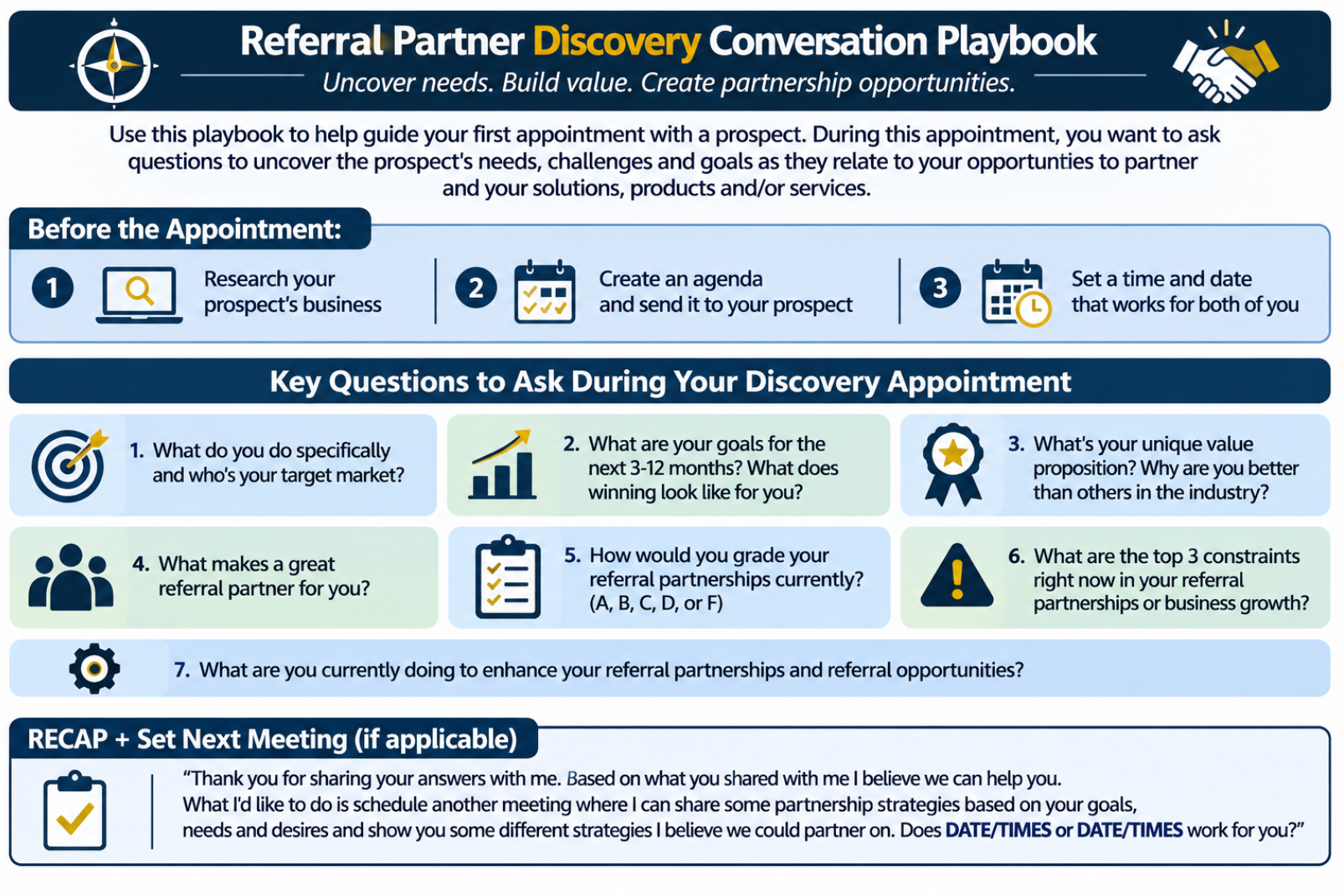
Seven Questions to Guide the Conversation
What do you do specifically, and who's your target market? Understand their business and the customers they serve.
What are your goals for the next 3 to 12 months? What does winning look like for you? Learn what they're working toward and how you might help.
What's your unique value proposition? Why are you better than others in your industry? Determine what differentiates them and makes them valuable to your clients.
What makes a great referral partner for you? Discover their expectations and what they value in a professional relationship.
How would you grade your current referral partnerships? A, B, C, D, or F? Identify how satisfied they are with their existing network.
What are the top three constraints in your referral partnerships or business growth? Uncover the problems preventing them from achieving better results.
What are you currently doing to enhance your referral partnerships and opportunities? Understand their current strategy and willingness to improve.
Listen More Than You Talk
The purpose of this conversation is discovery.
You should be doing more listening than presenting.
Research the prospect beforehand, establish an agenda, and arrive prepared to answer the same questions you ask.
One mistake I encourage people to avoid is trying to complete discovery and deliver a full partnership presentation in the same meeting.
Instead, use the first appointment to gather information and determine whether there's a good fit.
If you identify an opportunity, you might say:
"Based on what you've shared, I believe there are some opportunities for us to work together. I'd like to schedule another conversation to walk through a few partnership strategies that could help us both achieve our goals."
This creates a natural transition to the next appointment.
ACTION STEP: Create a standard Referral Partner Discovery Conversation Playbook using these seven questions. Schedule discovery appointments with your top prospects, evaluate their C.O.A.C.H. characteristics, and identify the strongest candidates for a follow-up partnership discussion.
PLAY 4: Present a Win-Win Partnership Strategy
Create Opportunities That Benefit Both Partners
Once you've completed discovery, your next play is to propose a partnership that creates value for both parties.
One strategy I've used successfully is creating a Strategic Team of Advisors.
This is a group of trustworthy professionals with complementary expertise who can support my clients, prospects, and professional relationships.
When someone needs a resource outside my area of expertise, I can confidently introduce them to someone on my team.
That makes me more valuable to the people I serve.
It also creates an attractive opportunity for professionals who want to be included in a trusted referral network.
Three Levels of Referral Partnerships
I like to think about these relationships using a Good, Better, Best approach.
Partnership LevelRelationship StrategyGoodReciprocal referrals when opportunities naturally ariseBetterScheduled monthly or quarterly conversations to identify and exchange strategic introductionsBestCollaborative marketing initiatives, joint events, webinars, educational content, and other opportunities to generate value together
The difference comes down to how intentional you want the partnership to become.
At the Good level, referrals tend to be reactive.
At the Better level, partners proactively look for opportunities to help each other.
At the Best level, partners work together to create additional opportunities through shared relationships, expertise, and marketing.
Set Clear Expectations
One mistake is expecting every referral relationship to generate the same number or value of referrals.
That's rarely realistic.
Different partners have different markets, networks, and access to opportunities.
Instead of requiring a referral-for-referral exchange, establish expectations around communication, responsiveness, follow-up, and how you'll support each other.
Also, be careful about offering exclusive referral relationships too early. You want to make sure the relationship can produce sufficient value before limiting your ability to work with other professionals.
Make the First Deposit
I often compare relationships to a bank account.
You need to make deposits before expecting withdrawals.
Those deposits might include making an introduction, sharing an educational resource, inviting someone to an event, or helping solve a business problem.
When you're consistently creating value, you build the relationship equity that makes future referrals more likely.
ACTION STEP: Develop a simple Good, Better, Best partnership proposal. For your strongest prospective partners, identify at least one specific opportunity to provide value immediately and establish a recurring communication schedule.
PLAY 5: Overcome Objections and Build Confidence
Practice, Persistence, and Patience Create Stronger Partnerships
You're going to encounter objections when recruiting referral partners.
Someone may tell you they already have a referral partner, don't receive many referral opportunities, don't know your company, or aren't interested in another business relationship.
These responses are normal.
The key is to be prepared rather than becoming defensive or giving up too quickly.
One technique I've used throughout my career is the Feel, Felt, Found framework.
For example:
"I understand how you feel. Some of my best referral partners initially felt the same way. What they found after learning more about our approach was that we offered something different from the other companies they had worked with."
You can then ask whether they're open to a short conversation about those differences.
The objective is to help someone understand your unique value and determine whether there's a reason to continue the discussion.
Build Relationship Equity Through Consistent Value
Not every prospective partner will be ready immediately.
Some relationships require months of consistent communication before they begin generating opportunities.
That's why I emphasize three things:
Practice. Persistence. Patience.
Practice your message and responses to common objections.
Remain persistent in creating opportunities to connect and provide value.
Have patience while the relationship develops.
Remember, you can't expect to harvest something immediately after planting the seed.
The more consistently you contribute value, the more opportunity you create to earn trust and become a recommended resource.
ACTION STEP: Identify the five objections you hear most frequently from prospective referral partners. Write and practice a response to each using Feel, Felt, Found. Develop a follow-up process that continues providing value to prospects who aren't ready to commit.
PLAY 6: Gain Commitment and Define the Next Play
Move From Interest to a Clear Partnership Agreement
A productive discovery meeting doesn't automatically create a productive referral partnership.
At some point, you need to ask whether the person is willing to move forward.
One of my favorite approaches is:
"If I was willing to [provide specific value], would you be open to [specific partnership opportunity]?"
For example:
"If I was willing to introduce you to qualified business owners who could benefit from your expertise, would you be open to meeting quarterly to explore opportunities where we could support each other?"
This gives the other person an opportunity to make a decision.
It also communicates that you're willing to contribute to the relationship.
Be the Quarterback
In football, the quarterback helps direct the offense, communicate the play, and move the team forward.
Referral partnerships also need someone willing to take responsibility for moving the relationship forward.
Be clear about what you're proposing, explain the next step, and ask for agreement.
You also need to recognize that people make decisions differently.
Some professionals are comfortable moving quickly. Others prefer to build familiarity before making commitments.
Adjust your approach to the individual without losing sight of the objective.
The goal is a clear, mutually understood commitment to taking the next step.
ACTION STEP: Develop a partnership commitment question that communicates what you're willing to contribute and what you'd like the other person to do in return. End every promising partnership conversation with an agreed-upon next step and a date to follow through.
PLAY 7: Deliver Value and Ask for Opportunities
Become the Partner People Want to Recommend
The final play is where the earlier work begins to pay off.
You've identified the right partners, earned appointments, discovered their goals, proposed a strategy, overcome concerns, and gained commitment.
Now you need to consistently demonstrate your value.
One of the easiest ways to do that is to become a connector.
You can introduce people to prospective clients, professional service providers, vendors, strategic partners, and other helpful resources.
You can also provide encouragement, share educational resources, or recognize someone publicly for the value they bring to others.
Use Social Media to Strengthen Your Partnerships
I like to recognize referral partners on LinkedIn and other social platforms.
For example, you might publish a post introducing a trusted partner, describing their expertise, and encouraging people in your network to connect with them.
That simple activity accomplishes several things.
It strengthens your relationship with the partner, increases their visibility, and helps position you as someone who actively supports other professionals.
As you become more visible and helpful, people begin thinking of you when relevant opportunities come along.
Your existing partners may even introduce you to other professionals who could become valuable members of your network.
Earn the Right to Ask
Once you've built relationship equity, ask for opportunities.
That might mean asking for an introduction to a potential client, an invitation to participate in a joint event, or a recommendation to another strategic partner.
You can also ask a more open-ended question:
"Is there anyone in your network right now who could benefit from my expertise, resources, or support?"
The important thing is that you're consistently delivering value and maintaining an active relationship.
ACTION STEP: Choose five current or prospective referral partners and provide each with something valuable this week. Make an introduction, share a resource, promote their expertise, or invite them to collaborate. Then identify an appropriate opportunity to ask how you might help each other.
THE 90-DAY REFERRAL PARTNERSHIP EXECUTION PLAN
A great playbook only produces results when you consistently run the plays.
Here's how I recommend organizing your first 90 days.
Days 1–30: Build Your Roster and Start Prospecting
Identify the professional categories most likely to serve your ideal clients.
Create your Referral Partner Depth Chart with at least three prospects per category.
Evaluate existing referral relationships and prioritize opportunities.
Review your LinkedIn connections and other professional networks.
Create a value-first outreach process.
Begin scheduling discovery conversations.
ACTION STEP: Complete your initial depth chart, prioritize your strongest partner prospects, and launch a consistent outreach process.
Days 31–60: Deepen Relationships and Propose Partnerships
Conduct discovery conversations using the seven questions.
Evaluate each prospect's goals, audience, and potential.
Identify opportunities where you can provide value.
Present Good, Better, Best partnership strategies.
Establish expectations for communication and follow-up.
Ask qualified partners to commit to a specific next step.
ACTION STEP: Prioritize the relationships showing the strongest mutual potential and develop specific partnership plans for those individuals.
Days 61–90: Activate, Measure, and Expand
Begin holding regular strategic partner conversations.
Make introductions and share relevant resources.
Identify opportunities for joint webinars or marketing.
Recognize referral partners publicly when appropriate.
Track introductions, meetings, and referrals.
Evaluate which relationships are producing the greatest value.
Refine your process before expanding automation.
ACTION STEP: Review your referral partner activity, identify the strategies producing the best results, and create an ongoing calendar for nurturing and expanding your strongest partnerships.
THE FINAL PLAY: Execute With Consistency
One of the biggest lessons I've learned from building businesses and playing football is that consistency matters.
You can have a great strategy, talented people, and all the right tools, but somebody still needs to execute the plays.
Referral partnerships are no different.
When you recruit the right partners, understand their goals, consistently provide value, and maintain clear communication, you put yourself in a much stronger position to generate qualified referrals.
And as those relationships deepen, the opportunities can multiply.
Start by identifying the right players. Build your roster. Practice your approach. Develop the relationships. Measure what's working.
Then use technology, automation, and AI where appropriate to help you execute more consistently and efficiently.
You don't need hundreds of referral partners to create meaningful results.
A focused team of trusted professionals who share your commitment to helping others can become one of your most valuable sources of new business.
Your next play: Choose the first referral partnership strategy you're going to implement, put it on your calendar, and take action.
About David Bush and BDR.ai
David Bush is the Co-Owner of BDR.ai and creator of the Business Builder's Playbook series, which helps entrepreneurs, business owners, and sales professionals develop practical systems to generate opportunities and grow their businesses.
BDR.ai helps businesses strengthen their prospecting and business development activities through premium prospect data, digital outreach, AI, automation, and appointment-setting support.
To learn more about building and scaling your Referral Partnership Playbook, visit www.bdr.ai.