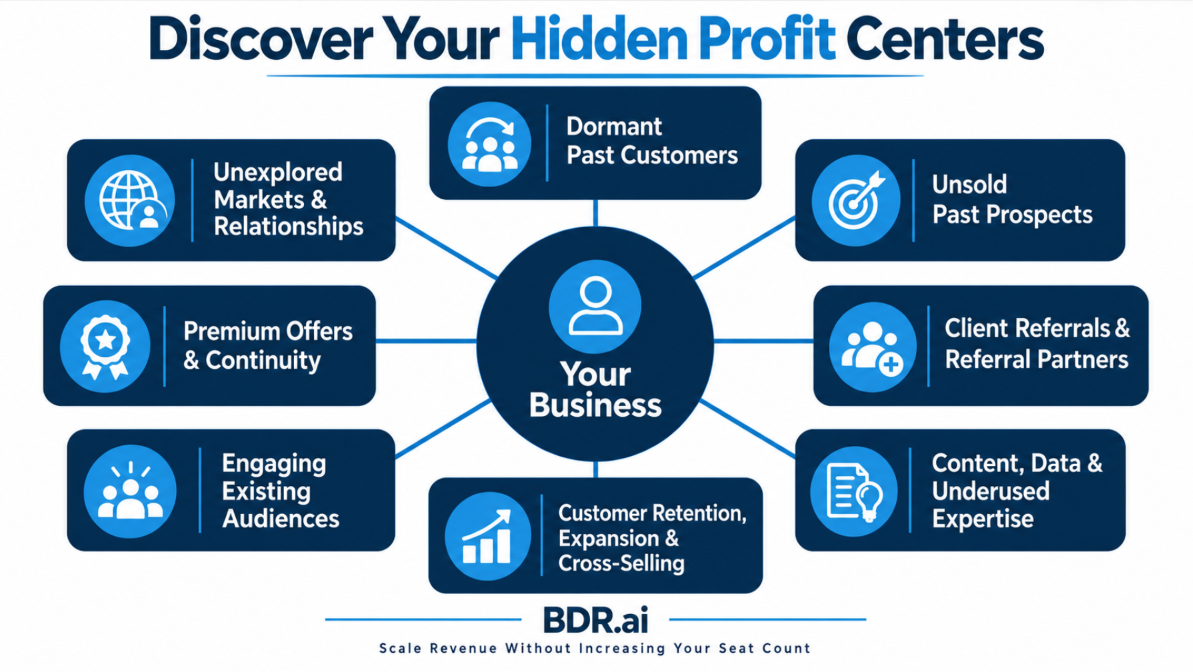
What if your next $50,000 or $100,000 in revenue could come from relationships, opportunities, and assets you already have?
Before you invest more money generating new leads, hiring another salesperson, or increasing your marketing budget, take a closer look at what's already inside your business.
You may be sitting on valuable opportunities that have simply been overlooked or underdeveloped.
Think about it.
Former customers who haven't purchased in a while.
Prospects who received proposals but never made a decision.
Referral partners who already know your ideal customers.
LinkedIn connections and email subscribers you rarely engage.
Content and expertise you could turn into new sales opportunities.
Existing customers who could benefit from additional services.
Services you could package into premium or recurring revenue programs.
New markets where your existing solutions could solve similar problems.
I call these Hidden Revenue Plays.
I've spent years helping business owners build better business development systems, and one thing I've learned is that opportunity and execution are two different things.
You can have thousands of qualified prospects, hundreds of LinkedIn connections, great referral relationships, and an excellent product or service.
But if nobody is consistently developing those relationships, following up, making offers, and creating conversations, much of that potential goes unrealized.
That's why I encourage business owners to follow a simple process:
Find the opportunity. Build the playbook. Run the plays. Keep score.
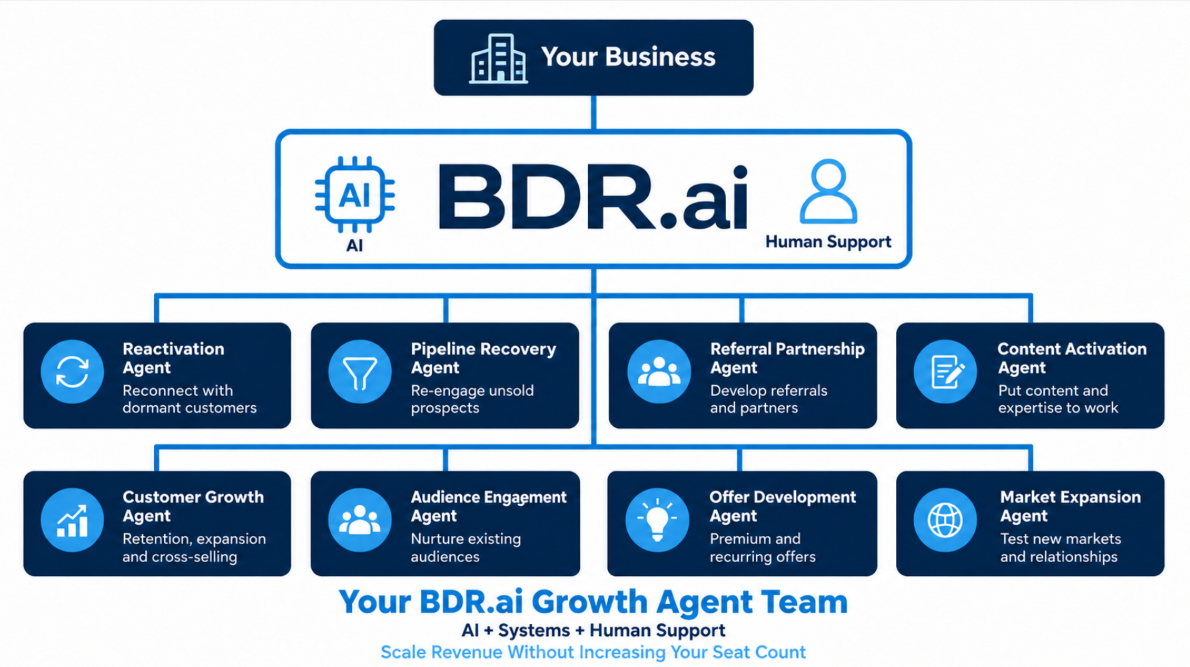
Let's walk through eight Hidden Revenue Plays you can begin using to grow your business, how to execute each one yourself, and how BDR.ai can help you do it more consistently using technology, AI, and virtual business development support.
You don't need to run all eight plays at once.
Start by identifying the one with the greatest potential for your business.
Play 1: Reactivate Dormant Customers and Old Leads
The opportunity: Generate new business from people who already know you.
How many names are sitting inside your CRM right now?
500? 2,000? 10,000?
Maybe you've been in business for 10 or 20 years and have accumulated thousands of contacts from previous sales conversations, networking activities, webinars, referrals, and past customers.
When was the last time you reached out to them?
I regularly meet business owners who are spending thousands of dollars trying to attract new prospects while overlooking people who have already expressed interest in their services.
A prospect who wasn't ready six months ago may be ready today.
A former customer may have a new need.
Someone who said no last year might be interested in a different solution now.
Businesses change. Budgets change. Priorities change.
Don't assume an old lead is a dead lead.
How to Run This Play Yourself
Export your database. Pull together past customers, inactive leads, former prospects, previous webinar attendees, and older inquiries.
Clean and segment your list. Organize contacts by industry, company size, previous interest, last interaction, services purchased, and potential value.
Create a compelling reason to reconnect. Offer a helpful resource, webinar, industry update, new solution, assessment, or invitation to revisit an earlier conversation.
Develop a follow-up sequence. Plan several relevant interactions over the next 30 to 60 days instead of relying on a single email.
Use multiple channels when appropriate. Coordinate email, LinkedIn, phone, and educational content based on the relationship and the contact's preferences.
Track your results. Measure responses, positive conversations, appointments, qualified opportunities, and new business.
Sample Reactivation Message
Subject: Thought of you when we put this together
Hi [First Name],
It's been a while since we last connected, and I wanted to reach out.
We've recently been helping business owners identify revenue opportunities they may already have inside their business, especially with past customers, old leads, and referral relationships.
I thought you might find this helpful:
[Link to Article or Resource]
I'd enjoy hearing what you're working on these days and exploring whether there might be an opportunity to reconnect.
Would you be open to a brief conversation?
How BDR.ai Can Help
BDR.ai can help organize and segment your database, identify higher-priority opportunities, develop relevant messaging, and coordinate outreach campaigns.
Our systems can assist with repetitive activities, while human business development representatives can help manage responses, nurture interested prospects, and arrange qualified conversations.
That reduces the amount of time the owner or sales team spends managing administrative outreach and follow-up.
Example: Imagine having 5,000 inactive contacts. Rather than contacting everyone with the same sales pitch, you segment the most relevant prospects and invite them to an educational webinar that addresses a current business challenge.
The webinar provides a useful reason to reconnect. Interested participants can then be invited into an appropriate follow-up conversation.
Keep score: Reactivated contacts, positive replies, qualified opportunities, appointments, and recovered revenue.
Play 2: Reopen Unsold Prospects and Lost Proposals
The opportunity: Recover business from sales opportunities you've already invested in developing.
Here's a situation almost every business owner has experienced.
You meet with a prospect.
The conversation goes well.
You prepare a proposal, present your solution, and discuss the next steps.
Then the prospect disappears.
You send a couple of follow-up emails, leave a voicemail, and eventually move on to the next opportunity.
Sound familiar?
The prospect may have been interested, but another priority came up. Maybe the budget wasn't approved, the timing was wrong, or an internal decision got delayed.
That doesn't necessarily mean the opportunity is gone.
I'd encourage you to review how much potential revenue is currently sitting in proposals that never closed.
How to Run This Play Yourself
Review your CRM and proposal history. Identify unsold prospects from the last 12 to 24 months.
Prioritize your opportunities. Focus on prospects that fit your ideal customer profile, expressed meaningful interest, and have sufficient potential value.
Identify why the sale stalled. Separate timing issues from pricing objections, competitive losses, missing decision-makers, and proposals that simply received no response.
Create a new reason to reconnect. Share an updated solution, a relevant case study, a new offer, or a useful insight related to the prospect's original needs.
Build a consistent follow-up process. Use a CRM to schedule the appropriate next action and personalize outreach based on the previous conversation.
Personally engage your highest-value opportunities. These prospects deserve more than an automated message.
What's the Potential Revenue?
Let's use a hypothetical example.
Suppose your business has:
200 past proposals that didn't close.
An average potential sale of $10,000.
A successful reactivation rate of 5%, creating 10 renewed opportunities.
A closing rate of 20% on those renewed opportunities.
That would produce two new customers.
2 customers × $10,000 = $20,000 in additional gross revenue.
These are illustrative assumptions, not a projection or guaranteed outcome. Actual results depend on prospect quality, timing, demand, and sales execution.
Still, it's worth asking what could happen if you revisited your old pipeline before spending money creating an entirely new one.
How BDR.ai Can Help
BDR.ai can help organize stalled opportunities, segment prospects based on their previous interests, build follow-up campaigns, and identify when someone wants to restart the conversation.
Our virtual business development support can then assist with qualifying responses and coordinating appointments.
Your sales team gets more time to focus on serious opportunities.
Keep score: Reopened conversations, proposals reconsidered, appointments, recovered deals, and revenue.
Play 3: Build a Referral and Strategic Partnership Engine
The opportunity: Develop relationships with people who already have the trust of your ideal customers.
Some of the best business opportunities I've experienced have come through introductions from people who knew, liked, and trusted both parties.
Think about your ideal customer.
Who else serves them?
Who advises them?
Who already has a relationship with them?
Depending on your business, potential referral partners might include:
CPAs and financial advisors
Attorneys and bankers
Business coaches and consultants
EOS Implementers
Vistage Chairs and C12 Chairs
Technology providers
Association leaders
Other companies offering complementary services
A well-developed referral partnership can create opportunities for both businesses.
But partnerships require attention.
A connection on LinkedIn isn't automatically a referral partner. Somebody has to develop the relationship, understand how each party can help, and stay engaged.
How to Run This Play Yourself
Define your ideal referral partner. Identify professionals and companies that serve the same audience without directly competing with you.
Build a list of 50 to 100 potential partners. Start with people in your existing network before expanding into new relationships.
Research their business. Understand whom they serve, their strengths, and where there may be mutual value.
Lead with an opportunity to help them. Look for useful introductions, shared resources, educational events, or ways to support their customers.
Create a collaborative activity. Consider a co-hosted webinar, interview, referral education session, or jointly developed resource.
Follow up consistently. Schedule regular touchpoints and measure introductions, referrals, and business opportunities.
Sample Referral Partner Message
Hi [First Name],
I noticed we both work with [type of customer], and I thought there might be an opportunity for us to collaborate.
I'm always interested in building relationships with professionals who are helping similar businesses solve different problems.
I'd enjoy learning more about your business, the clients you serve, and whether there are opportunities to help each other.
Would you be open to connecting?
How BDR.ai Can Help
We can help identify qualified referral partners, research their businesses, develop personalized outreach, coordinate LinkedIn and email follow-up, promote collaborative webinars, and organize relationship-building activities.
You still develop the trust and the partnership.
Our role is to help make sure the prospecting, introductions, invitations, and follow-up happen consistently.
Keep score: New partner conversations, active partners, introductions, qualified referrals, and business generated.
Play 4: Turn Your Content, Data, and Expertise Into Revenue
The opportunity: Package what you already know into content that attracts qualified business opportunities.
If you've been in business for any length of time, you've probably accumulated a lot of valuable knowledge.
You may have years of presentations, training programs, articles, webinars, interviews, case studies, checklists, and recorded conversations.
Think about the questions your customers ask you repeatedly.
You've probably answered some of them hundreds of times.
What if you could turn that expertise into a marketing campaign that works for you long after the original conversation?
I particularly like live Q&A webinars because they allow a business owner to demonstrate expertise while directly addressing the problems potential customers want to solve.
And one good webinar can become multiple marketing and sales assets.
How to Run This Play Yourself
Identify one important problem your ideal customers want to solve. Choose a topic where you have meaningful experience and useful answers.
Create a webinar or interview. Prepare seven to ten questions that address the audience's biggest challenges.
Invite the right people. Promote the event to existing customers, prospects, LinkedIn connections, email subscribers, and referral partners.
Record the conversation. Use the recording as the foundation for additional educational resources.
Repurpose the content. Turn it into short video clips, articles, email resources, LinkedIn posts, checklists, or a 10-to-15-page lead magnet.
Follow up with interested participants. Offer the recording, supporting resources, or an appropriate next conversation.
Example: One Webinar, Multiple Opportunities
Imagine you're a business consultant who specializes in helping owners increase profitability.
You host a 45-minute Q&A webinar answering questions about pricing, operating costs, cash flow, and improving profit margins.
From that one event, you could create:
A full webinar recording.
Five short educational video clips.
A downloadable profitability checklist.
Several LinkedIn posts.
A blog article.
An email follow-up series.
An invitation to a profitability assessment.
You now have a collection of educational assets that can support conversations with potential customers for months.
How BDR.ai Can Help
This is one of the reasons we developed our hosted webinar services and Content to Client Engine.
BDR.ai can help coordinate the webinar, registration experience, audience outreach, supporting content, and follow-up campaign.
The goal is to help you get more value from the expertise you've already developed without having to become a full-time content creator or marketing campaign manager.
Keep score: Registrations, attendees, content engagement, qualified leads, booked conversations, and customers.
Want help identifying which Hidden Revenue Play deserves your attention first?
Schedule a 30-Minute Business Builder's Playbook Review
Play 5: Expand Your Existing Customer Relationships
The opportunity: Increase customer lifetime value by helping existing customers solve additional problems.
Your existing customers already have experience working with you.
They understand your services.
They've seen how your business operates.
Hopefully, you've earned their trust by delivering real value.
Yet many companies spend most of their marketing and sales resources trying to acquire new customers while overlooking opportunities to serve the customers they already have.
Here are a few questions worth asking:
What other problems are your customers experiencing?
Which of your services are they not currently using?
Could additional training, implementation support, maintenance, consulting, or managed services help them achieve better outcomes?
This play works best when you begin with genuine customer needs.
How to Run This Play Yourself
Review your active customers. Document their current services, purchase history, contract dates, and business needs.
Identify potential service gaps. Look for complementary solutions that could help them achieve better results.
Segment customers by opportunity. Organize accounts by the additional services most relevant to them.
Create an educational campaign. Explain the problems those services solve and the benefits customers may receive.
Schedule periodic account reviews. Use these conversations to understand changing needs and identify opportunities to help.
Track retention and expansion. Measure renewals, additional purchases, average customer revenue, and customer satisfaction.
Example: Managed IT and Cybersecurity
Imagine an IT services provider already supports 200 small and midsize businesses.
Some clients may need additional cybersecurity assessments, employee training, backup services, or security monitoring.
Before spending heavily to reach hundreds of new companies, the provider could review its existing customers' needs and offer relevant assessments.
A well-timed conversation may uncover a service that benefits the customer and creates additional revenue.
How BDR.ai Can Help
BDR.ai can help organize account data, segment customers by potential interest, create educational campaigns, coordinate webinar invitations, and support appropriate follow-up.
Customer relationships and sensitive account conversations should remain under the direction of the account owner or responsible team.
Keep score: Account reviews, expansion opportunities, additional revenue per customer, renewals, and retention.
Play 6: Activate Your Existing Network and Turn Connections Into Opportunities
The Opportunity: Turn your existing LinkedIn connections and professional relationships into a consistent source of conversations, referrals, and new business.
How many first-degree LinkedIn connections do you have?
1,000? 3,000? 10,000?
Now ask yourself, how many of those people have you communicated with in the last 90 days?
Most business owners have spent years building professional networks, email lists, and LinkedIn connections. Unfortunately, many of those relationships receive little attention after the initial connection.
Meanwhile, owners spend more time and money trying to reach new prospects.
Your existing network may be one of your most valuable and underutilized business development assets.
The opportunity is to consistently engage, educate, and nurture these relationships so more connections become meaningful conversations, referral partners, and potential customers.
How to Run This Play Yourself
Inventory your network. Review your first-degree LinkedIn connections, email subscribers, past webinar participants, and professional relationships.
Organize and prioritize. Identify potential customers, referral partners, and strategic relationships based on your ideal customer profile.
Create a Give-Give-Ask sequence. Develop helpful messages that share valuable articles, videos, educational resources, and webinar invitations before asking for a conversation.
Engage across multiple channels. Use LinkedIn messages, event invitations, relevant profile and post interactions, emails, and personal follow-up.
Develop a nurturing schedule. Plan consistent communication over 30 to 90 days, adjusting your outreach based on individual responses and interests.
Track and follow up. Use a CRM to organize conversations, identify positive interest, and schedule next steps.
How BDR.ai Can Help
Imagine having 3,000 LinkedIn connections and a virtual business development team helping you consistently engage and nurture the most valuable relationships without personally managing every interaction.
BDR.ai helps turn your existing network into an active business development engine.
Here's how:
Source and organize: Identify and organize your first-degree LinkedIn connections and other qualified contacts.
Segment and prioritize: Identify ideal prospects, referral partners, and strategic relationships based on industry, job title, company size, geography, and potential value.
Build multi-channel sequences: Coordinate LinkedIn messages, event invitations, emails, profile visits, post engagement, educational content, and relevant follow-up.
Automate relationship nurturing: Schedule and manage appropriate communications, share valuable resources, and maintain consistent engagement over time.
Manage responses and opportunities: Use AI-powered systems and virtual BDR support to organize replies, prioritize interested prospects, nurture conversations, and help schedule appointments.
Example: Activate 3,000 LinkedIn Connections
Imagine you have 3,000 first-degree connections but rarely communicate with most of them.
BDR.ai helps you identify 1,000 high-priority prospects and referral partners, organize them into targeted audiences, and develop a 30-to-90-day engagement campaign.
Your campaign combines LinkedIn messages, educational webinar invitations, relevant content interactions, email follow-up, and ongoing nurturing.
As connections engage, BDR.ai helps organize responses, identify potential opportunities, and coordinate conversations with interested prospects.
Instead of relying on occasional personal outreach, you now have a consistent process for developing relationships and discovering new opportunities.
The advantage: Increase the quantity, quality, and consistency of your relationship-building activities while spending less time managing repetitive outreach and follow-up. Automation and human support work together, with outreach tailored to each audience and applicable communication requirements.
Keep Score
First-degree connections activated, priority prospects identified, engagement activities, positive replies, meaningful conversations, webinar registrations, referral opportunities, appointments, and new customers.
You've already invested years building your network. BDR.ai helps you turn those connections into more quality relationships, conversations, and business opportunities.
Play 7: Create Premium Offers and Recurring Revenue
The opportunity: Increase revenue by packaging your existing capabilities in a way customers value.
Sometimes a company has an excellent service but hasn't fully explored the different ways customers might purchase it.
A consultant may sell individual projects but have clients who would benefit from ongoing advisory support.
A training company may sell one-time workshops while customers need recurring employee development.
A technology provider may deliver implementations but also have opportunities for ongoing managed services.
Start by looking at the outcomes your customers want and the level of ongoing support they need.
Could your existing expertise support a premium offer, monthly advisory relationship, membership, managed service, or recurring program?
How to Run This Play Yourself
Identify problems that require ongoing support. Review customer feedback, recurring requests, and opportunities where continued involvement would add value.
Define the customer outcome. Make it clear what the program is intended to accomplish.
Package your services. Establish deliverables, access, service levels, responsibilities, and support.
Set sustainable pricing. Consider delivery costs, margins, capacity, and customer value.
Test your offer with existing relationships. Get feedback from customers and warm prospects before committing major resources.
Develop an enrollment process. Use educational content, conversations, demonstrations, and clear proposals.
Measure retention and profitability. Recurring revenue only creates a healthy business when customers continue receiving value.
What's the Revenue Potential?
Consider a consultant who develops a $2,500-per-month advisory program.
If the business enrolls 10 clients, that produces:
10 clients × $2,500 = $25,000 in monthly recurring revenue.
At a constant 10 active clients, that represents $300,000 in annualized gross recurring revenue before expenses, churn, and other adjustments.
This is a hypothetical model, not a sales forecast.
It demonstrates how thoughtful packaging can change the economics of an existing service.
How BDR.ai Can Help
BDR.ai can assist with the marketing and business development side of launching a premium or recurring program.
That may include audience research, offer positioning, landing pages, lead magnets, webinar campaigns, targeted outreach, follow-up, and appointment setting.
Your business remains responsible for designing and delivering the offer.
Keep score: Qualified enrollment conversations, new subscriptions, monthly recurring revenue, delivery margins, and customer retention.
Play 8: Test New Markets and Strategic Relationships
The opportunity: Find new customers who need solutions you already provide.
You may have developed a successful product or service for one type of customer without exploring whether it could also benefit another industry, market, or business segment.
For example, a company serving professional services firms might discover that its solution is also useful for manufacturers, contractors, healthcare organizations, or technology providers.
But entering a new market can be expensive.
Hiring people, building campaigns, and investing heavily in advertising before validating demand creates unnecessary risk.
I'd rather see a business run a focused test first.
How to Run This Play Yourself
Identify two or three adjacent markets. Look for industries, customer types, or geographic markets with similar problems.
Research each market. Understand the business challenges, buying process, decision-makers, and competitors.
Build a focused prospect list. Begin with a manageable group of qualified companies instead of purchasing a massive database.
Adapt your messaging. Speak to the needs and terminology of each market.
Launch a 60-to-90-day test. Use targeted outreach, educational content, interviews, and relevant offers.
Measure market response. Track conversations, qualified leads, appointments, proposals, and closed sales.
Evaluate the results. Decide whether the market deserves additional investment, a different approach, or no further pursuit.
Example: Entering an Adjacent Market
Suppose your company has built a successful business providing leadership development services to professional services firms.
You believe the same solution could help construction businesses struggling with supervisor development and employee retention.
Rather than immediately hiring a new salesperson, you could identify 200 relevant construction company leaders and run a focused campaign.
Invite them to an educational webinar or interview about developing stronger frontline leaders.
Use the resulting conversations to understand market demand, the problems that matter most, and whether customers will pay for your solution.
How BDR.ai Can Help
BDR.ai can help research adjacent markets, source qualified prospects, develop targeted messaging, coordinate outreach, promote educational events, and track early market engagement.
You can use that information to make better-informed decisions about future investment.
Keep score: Qualified market response, sales opportunities, customer acquisition costs, closed revenue, and profitability.
Which Hidden Revenue Play Should You Run First?
You've now seen eight different ways to identify potential revenue opportunities inside your business.
But here's where I see business owners make a common mistake.
They get excited about several ideas and try to execute too many things at once.
Then the day-to-day demands of running the business take over, and the new initiatives lose momentum.
I recommend starting with one play.
The best opportunity will depend on your business, the relationships and assets you've developed, and your ability to execute.
Your Hidden Revenue Opportunity Highest Priorities
Take a few minutes to evaluate each of the eight plays.
1. Revenue Potential: How much additional revenue could this opportunity realistically generate?
2. Existing Assets: Do you already have the contacts, relationships, content, customer base, or capabilities necessary to pursue it?
3. Speed to Opportunity: How quickly could you begin generating meaningful conversations or qualified opportunities?
4. Execution Readiness: Do you have the people, technology, time, and resources to act consistently?
Rank these plays in order of importance (1 = highest priority)
____ Dormant Customers and Old Leads
____ Unsold Prospects and Lost Proposals
____ Referral and Strategic Partners
____ Content, Data, and Expertise
____ Existing Customer Expansion
____ Existing Audience Engagement
____ Premium and Recurring Offers
____ New Markets and Relationships
The scorecard is a simple prioritization tool, not a financial projection. If two plays have similar priorities, look more closely at the potential value, required investment, and likelihood of turning interest into sales.
Now ask yourself:
Which play could we realistically launch within the next 30 days, and who is going to run it?
That question brings us to an important part of business development.
The Real Challenge: Consistent Execution
I regularly work with business owners who understand what they should be doing to grow their business.
They know they need to prospect.
They know they need to follow up.
They know referrals are valuable.
They understand the importance of educational content, networking, and nurturing relationships.
The problem is finding enough time and resources to do those things consistently.
A busy owner might personally send 50 carefully researched LinkedIn invitations and messages in a month.
They may do a great job personalizing every message.
But when client demands increase, business development activity declines.
Another business owner might use technology and virtual business development support to manage a much larger amount of qualified outreach and follow-up every month.
The messages still need to be relevant, respectful, and useful.
The advantage comes from having a defined process that can operate consistently without depending on the owner's availability for every activity.
Quality and quantity both matter.
A thousand poorly targeted messages won't create a healthy business development system.
But excellent messaging that rarely reaches anyone also has limited potential.
The goal is to find the right balance between qualified targeting, useful messaging, consistent activity, and timely human engagement.
That's the problem we're working to solve at BDR.ai.
How AI and Human Support Can Work Together
Technology is useful for handling repetitive activities and organizing information.
Depending on the campaign and service configuration, AI and automation can assist with:
Prospect research and audience segmentation.
Organizing data and campaign lists.
Preparing and managing outreach workflows.
Supporting content creation.
Tracking campaign activities and engagement.
Identifying contacts who require follow-up.
Managing appropriate reminders and next steps.
Human business development representatives can help by:
Reviewing responses and recognizing buying intent.
Personalizing important conversations.
Qualifying interested prospects.
Coordinating appointments.
Keeping CRM records and next actions organized.
Bringing questions or important opportunities to the business owner.
The business owner or sales team remains responsible for developing key relationships, evaluating opportunities, presenting solutions, and closing business.
The specific services and responsibilities should be defined before launching a campaign. All outreach should respect applicable laws, communication preferences, and platform requirements.
DIY vs. BDR.ai: Choosing the Right Way to Execute
Every business owner has different needs, resources, and levels of involvement.
Some owners enjoy doing their own prospecting and relationship development.
Others would rather spend their time meeting with qualified prospects, serving customers, and leading the business.
BDR.ai offers three approaches designed to fit those different needs.
Done BY You
You and your team run the plays.
BDR.ai provides access to applicable tools, playbook resources, training, and support that help you organize and execute your business development activities.
This approach is a good fit when you have the time and internal resources to manage the work.
Done WITH You
Your team remains involved in execution while BDR.ai provides additional strategy, technology, training, coaching, and support.
This can work well for owners who want to keep business development internal but need help improving the process and consistency.
Done FOR You
BDR.ai provides additional business development execution capacity through available technology, systems, and human support.
Depending on the program, that can include prospect research, outreach support, response management, nurturing, and appointment-setting assistance.
This option is designed for owners who want to spend less time managing repetitive business development activities.
The right choice depends on your budget, existing team, growth goals, and the amount of execution support you need.
Our objective is to help you run the right plays with a practical combination of strategy, systems, solutions, support, and staff.
What Consistent Business Development Can Look Like
Let me give you a real example.
During one of our webinars, Jim Padilla of Gain The Edge shared results from a 60-day period of business development activity supported by BDR.ai.
Jim reported approximately:
1,200 LinkedIn outreach activities
382 responses and replies
156 webinar registrations
24 booked phone conversations
These figures were reported by Jim during the webinar and represent campaign activity and engagement outcomes. They should not be interpreted as 382 unique qualified leads, 24 completed sales meetings, or a specific amount of closed revenue.
The important point is what consistent execution made possible.
The outreach, educational invitations, follow-up activities, and conversations were all part of a coordinated effort.
Rather than expecting the owner to personally manage every task, the campaign used technology and business development support to create more consistent activity.
Those are the kinds of activities business owners should be measuring.
Build a Scoreboard That Measures What Matters
Whatever play you choose, track both the work being performed and the business results.
Your scoreboard should include:
Business Development Activity
Qualified prospects identified.
Outreach activities completed.
Follow-up activities completed.
Educational invitations delivered.
Market Engagement
Connection acceptance rates.
Replies and meaningful conversations.
Positive interest expressed.
Webinar registrations and attendance.
Business Outcomes
Qualified leads.
Booked and completed appointments.
Sales opportunities.
New customers.
Revenue attributed to the campaign.
Activity is useful because you can manage it.
Revenue matters because it helps you determine whether the effort is worthwhile.
You need visibility into both.
I would never promise a business owner that technology or a business development service can guarantee a specific number of sales.
There are too many factors beyond anyone's control, including market conditions, buyer readiness, competition, the quality of the offer, and the sales process.
What we can work to make more consistent and measurable is the process of identifying opportunities, reaching qualified prospects, following up, engaging interested people, and improving the campaign based on real feedback.
Your 30-Day Hidden Revenue Action Plan
If you've made it this far, I hope you're already thinking about which opportunity could have the greatest impact on your business.
Here's how I'd encourage you to get started.
Week 1: Identify the Opportunity
Complete the Hidden Revenue Opportunity Scorecard.
Review your existing customers, prospects, relationships, content, and capabilities.
Choose one play and establish a reasonable initial goal.
Week 2: Build the Playbook
Define your ideal audience, offer, messaging, follow-up process, and success measures.
Decide who will be responsible for each activity.
Week 3: Launch the Play
Begin outreach, reconnect with relationships, invite people to an event, or introduce your offer.
Focus on executing the planned activities and responding to interested prospects.
Week 4: Review the Scoreboard
Evaluate the activity, responses, conversations, opportunities, and business results.
Find out what worked and what needs improvement.
Then make the appropriate adjustments and continue running the play.
You may need more than 30 days to generate meaningful sales results, especially in markets with longer buying cycles. The first month should give you a clearer understanding of execution and early market response.
Which Hidden Revenue Opportunity Could Have the Biggest Impact on Your Business?
Maybe you have 5,000 dormant contacts sitting inside your CRM.
Maybe you've sent 200 proposals over the last two years that never converted into customers.
Maybe you know dozens of professionals who could become valuable referral partners.
Or perhaps you've spent years developing expertise that could be packaged into educational content, advisory programs, and new solutions.
There's a good chance you already have something worth building on.
The question is whether you have the strategy, people, technology, and consistent execution necessary to turn that opportunity into new business.
That's where we'd love to help.
Schedule Your 30-Minute Business Builder's Playbook Review
During this conversation, we'll discuss:
Your current business development activities and results.
Potential revenue opportunities you may be overlooking.
The obstacles preventing more consistent growth.
Which Hidden Revenue Plays deserve attention first.
Whether BDR.ai's Done BY You, Done WITH You, or Done FOR You support could help you execute.
Our goal is to help you leave with greater clarity about where to focus your business development efforts and what to do next.
SCHEDULE YOUR 30-MINUTE BUSINESS BUILDER'S PLAYBOOK REVIEW
You don't have to run eight new plays.
Start with one high-potential opportunity, develop a practical strategy, assign responsibility, and consistently execute.
Build a Better Playbook. Run Better Plays. Win More Business.