
Why You’re Struggling to Generate Leads
Most small business owners are not struggling because they are unwilling to do business development. They are struggling because their business development is often scattered.
They post occasionally.
They follow up when they remember.
They send a few connection requests.
They attend a networking event.
They try email.
They think about running ads.
They reconnect with a few old contacts.
Some of those activities may create results. Some may not. The problem is that without structure, it is hard to know what is working, what is missing, and what needs to be improved.
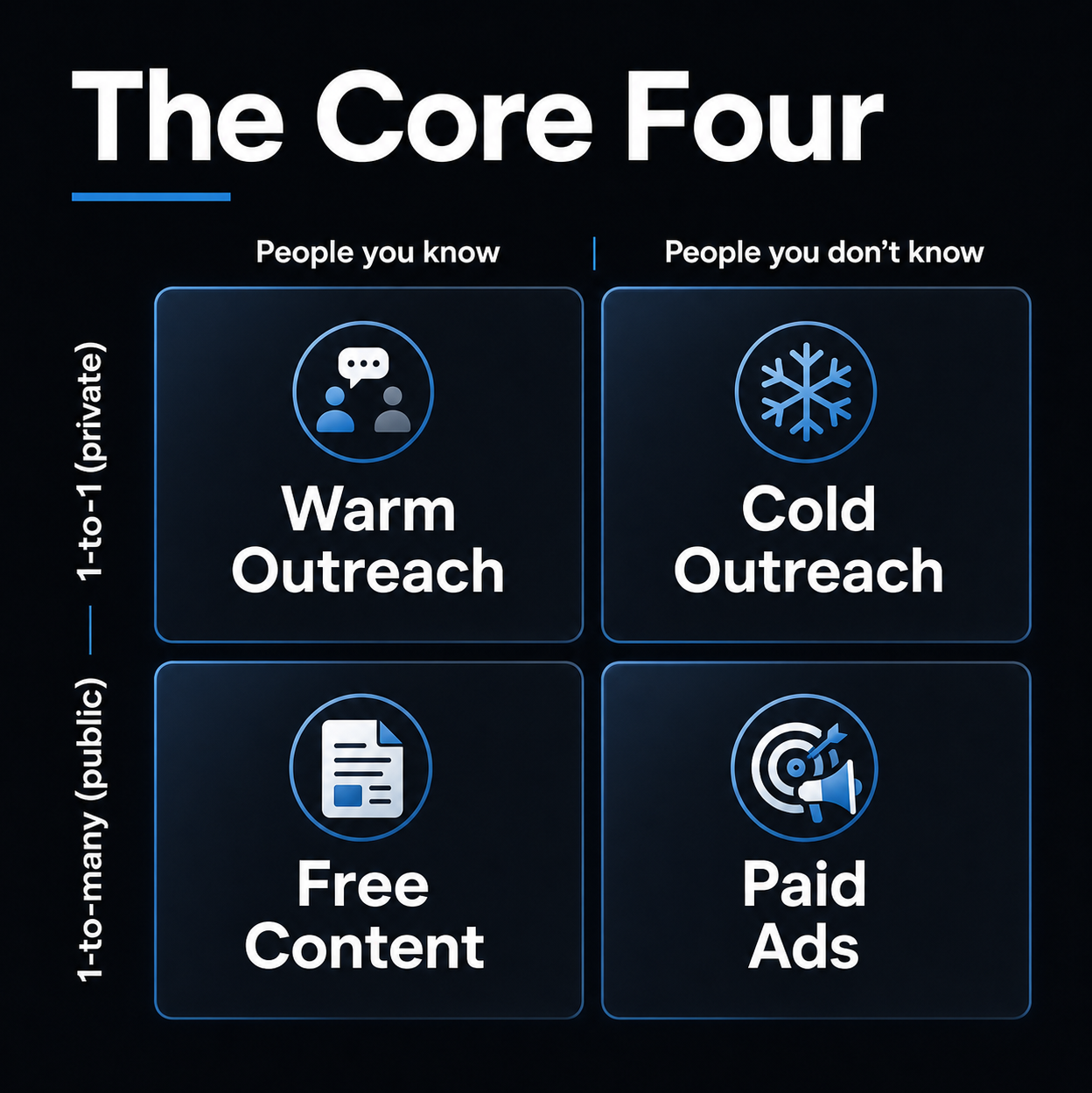
That is why it helps to organize business development around a simple framework:
The Core Four
Warm Outreach
Free Content
Cold Outreach
Paid Ads
These four categories give you a practical way to think about where your leads, conversations, referrals, and opportunities are coming from.
But here is the important part:
Doing the activities alone is not enough.
You can send messages, post content, attend events, run ads, and follow up with people and still not create predictable results.
Why?
Because every business development activity needs to communicate in a way that moves people forward.
That is where A.I.D.A. comes in.
What Is A.I.D.A.?
A.I.D.A. is a classic marketing and sales framework:
Attention — Get the right person to notice you.
Interest — Speak to something they care about.
Desire — Help them see the value of a better outcome.
Action — Give them a clear next step.
This applies to nearly every form of business development, including:
LinkedIn messages, emails, phone calls, social posts, webinars, podcast invitations, networking conversations, lead magnets, landing pages, ads, referral asks, and follow-up sequences.
If your message does not get attention, people ignore it.
If it does not build interest, people do not engage.
If it does not create desire, people do not see the value.
If it does not include action, people do not know what to do next.
The Core Four tells you where to focus your activity.
A.I.D.A. tells you how to make that activity work better.
1. Warm Outreach
Reconnecting With People Who Already Know You
Warm Outreach is your one-to-one follow-up with people who already have some level of relationship, trust, familiarity, or connection with you.
This may include:
Referral partners
Current clients
Past clients
Former prospects
Raving fan customers
Existing LinkedIn connections
People you met at events
Podcast guests or hosts
Strategic partners
Former colleagues
Professional friends
People who have engaged with your content
For many solopreneurs, advisors, coaches, consultants, and sales professionals, Warm Outreach is one of the fastest ways to create new opportunities because the relationship already exists.
You are not starting from zero.
But Warm Outreach often gets neglected because people assume their network already knows what they do, who they help, or how to refer them.
That is usually not true.
Your network may like you.
They may trust you.
They may even respect your work.
But if you are not regularly educating, adding value, creating clarity, and inviting conversation, they may not think of you when an opportunity appears.
Common Warm Outreach Activities
Warm Outreach can include:
Checking in with referral partners
Reconnecting with past clients
Following up with current prospects
Thanking someone for a referral
Sharing a helpful article or resource
Sending a personal video message
Asking a former client how things are going
Inviting a warm contact to a webinar or event
Introducing two people who could help each other
Asking a raving fan client who else they know who may benefit
Following up with people who liked, commented, or attended something
Why Warm Outreach Often Fails
Warm Outreach fails when it becomes too casual, too vague, or too self-serving.
Examples of weak warm outreach:
“Just checking in.”
“Hope all is well.”
“Let me know if you need anything.”
“Do you know anyone who needs my services?”
These messages are not necessarily wrong, but they often lack structure. They may be friendly, but they do not always create movement.
To make Warm Outreach more productive, use A.I.D.A.
A.I.D.A. Example for Warm Outreach
Situation:
A consultant wants to reconnect with a past client.
Attention:
“I was thinking about the work we did together last year and how many business owners are trying to simplify growth without adding more complexity.”
Interest:
“One thing I’m seeing often is that leaders have plenty of opportunities around them, but they do not always have a clear process for turning relationships into conversations.”
Desire:
“That is why I’ve been helping clients create a more intentional rhythm for follow-up, referrals, and relationship-based growth.”
Action:
“Would it be worth reconnecting for 15 minutes next week to hear what you are focused on this year?”
Another Warm Outreach Example
Situation:
An advisor wants to ask a referral partner for introductions.
Attention:
“I’ve been having more conversations with business owners who feel like their growth depends too much on referrals happening by chance.”
Interest:
“They usually have great relationships, but not a consistent way to stay visible, add value, and create the right introductions.”
Desire:
“I’m helping clients build a more structured relationship-based growth system so they can generate more warm conversations without feeling pushy.”
Action:
“If someone in your network is trying to grow more consistently this year, I’d be grateful for an introduction.”
Warm Outreach Takeaway
Warm Outreach works best when it feels personal, relevant, valuable, and clear.
Do not just check in.
Create a reason to reconnect.
2. Free Content
Building Trust and Visibility at Scale
Free Content is your one-to-many communication engine.
It allows people to learn from you before they ever speak with you.
This includes:
LinkedIn posts
Short videos
Educational graphics
Blog posts
Email newsletters
Podcasts
Webinars
Speaking engagements
Networking presentations
Live streams
Commenting thoughtfully on other people’s content
Lead magnets such as guides, checklists, and assessments
For a solopreneur, advisor, coach, consultant, expert, or sales professional, Free Content is one of the best ways to build authority and trust.
But content only works when it speaks to a specific audience with a specific message.
Posting random thoughts, motivational quotes, or generic tips may keep you visible, but it may not create a steady stream of business conversations.
Common Free Content Activities
Free Content can include:
Sharing practical tips your audience can use
Posting short stories from client conversations
Writing about common mistakes in your industry
Recording videos that answer frequently asked questions
Creating simple frameworks or checklists
Publishing a weekly newsletter
Writing a blog post about a recurring problem
Speaking on a podcast
Hosting a webinar or live Q&A
Turning a client success story into a lesson
Sharing observations from the marketplace
Why Free Content Often Fails
Free Content fails when it is too broad, too inconsistent, or too disconnected from the buyer’s real problems.
Common mistakes include:
Talking to everyone
Posting without a clear point
Educating without inviting action
Sharing expertise without connecting it to a problem
Creating content that sounds good but does not create interest
Forgetting to tell people what to do next
Content should not just prove that you are smart.
It should help the right people recognize a problem, understand the opportunity, and take a next step.
A.I.D.A. Example for Free Content
Situation:
A coach wants to write a LinkedIn post for business owners.
Attention:
“Most business owners do not have a time management problem. They have a priority problem.”
Interest:
“They are busy all day, but too much of their energy is spent reacting instead of leading, deciding, delegating, and building the future of the business.”
Desire:
“When you get clear on the highest-value activities only you should own, you can create more focus, more freedom, and better results from your team.”
Action:
“If you are feeling buried in the day-to-day, start by writing down the three activities that create the most value for your business this week.”
Another Free Content Example
Situation:
A sales professional wants to post about follow-up.
Attention:
“Most lost deals are not lost because the prospect said no. They are lost because the follow-up disappeared.”
Interest:
“People get busy. Priorities shift. Timing changes. A prospect who is not ready today may be very interested 30, 60, or 90 days from now.”
Desire:
“The professionals who win consistently usually have a simple follow-up rhythm that adds value without becoming annoying.”
Action:
“Look at your pipeline today and identify five people who deserve a thoughtful follow-up.”
Free Content Takeaway
Free Content should not be random visibility.
It should be value-driven communication that attracts the right people, builds trust, and creates opportunities for conversation.
3. Cold Outreach
Building New Relationships With People Who Do Not Know You Yet
Cold Outreach is one-to-one communication with people who do not already know you.
This may include:
LinkedIn connection requests
LinkedIn direct messages
Email outreach
Phone calls
Comments on posts from target prospects
Event follow-up
Conference outreach
Association networking
Podcast invitations
Group participation
Direct mail
Strategic partner outreach
Cold Outreach has a bad reputation because many people do it poorly.
They send generic messages.
They pitch too soon.
They automate without relevance.
They make the conversation all about themselves.
But when done thoughtfully, Cold Outreach can be one of the most powerful ways to create new relationships and new opportunities.
The key is to lead with relevance, value, and curiosity.
Common Cold Outreach Activities
Cold Outreach can include:
Connecting with ideal prospects on LinkedIn
Sending a short personalized introduction
Commenting on a prospect’s post before messaging them
Joining groups or associations where your target audience participates
Attending conferences where ideal clients gather
Inviting someone to be a podcast guest
Sharing a helpful resource with someone in a specific role
Following up after an event
Asking a thoughtful question related to their business
Introducing yourself around a shared industry, challenge, or interest
Why Cold Outreach Often Fails
Cold Outreach fails when it feels like a pitch instead of a conversation.
Weak cold outreach often sounds like:
“We help companies like yours increase revenue. Can we schedule a call?”
“I wanted to introduce my services.”
“Are you looking for help with sales or marketing?”
“Here is everything we do.”
Those messages may occasionally work, but they usually do not create predictable results because they skip the relationship-building process.
They ask for action before creating attention, interest, or desire.
A.I.D.A. Example for Cold Outreach
Situation:
A consultant wants to connect with a business owner on LinkedIn.
Attention:
“I noticed you work with a growing team in the professional services space.”
Interest:
“I’m always interested in how firms like yours are creating more consistent growth without putting all the pressure on referrals.”
Desire:
“I share ideas around relationship-based business development, follow-up, and practical growth systems for service-based companies.”
Action:
“Open to connecting?”
Cold Outreach Follow-Up Example
Situation:
The person accepts the connection request.
Attention:
“Thanks for connecting.”
Interest:
“One challenge I hear from a lot of service-based business owners is that they are great at delivering value, but they do not always have a consistent rhythm for creating new conversations.”
Desire:
“I’ve been sharing a few simple frameworks that help make business development more intentional without making it feel overly salesy.”
Action:
“Would it be helpful if I sent one over?”
Another Cold Outreach Example
Situation:
An expert wants to invite a potential prospect to be a podcast guest.
Attention:
“I came across your work and thought your perspective on leadership and growth would be valuable for my audience.”
Interest:
“I interview business leaders and experts about practical lessons other owners, advisors, and consultants can apply.”
Desire:
“It could be a great way to spotlight your expertise and create a useful conversation for people facing similar challenges.”
Action:
“Would you be open to exploring a possible guest conversation?”
Cold Outreach Takeaway
Cold Outreach should not feel cold, even when the relationship is new.
The best cold outreach is thoughtful, relevant, and designed to start a conversation.
4. Paid Ads
Amplifying What Is Already Clear and Compelling
Paid Ads are one-to-many activities where you invest money to increase visibility, traffic, awareness, leads, or opportunities.
This can include:
Search ads
Social media ads
LinkedIn ads
Retargeting ads
Sponsored newsletters
Event sponsorships
Trade shows
Paid directories
Paid webinar promotion
SEO support
Sponsored content
Bulk email campaigns
Paid Ads can be powerful, but they are not magic.
If your audience is unclear, your message is weak, your offer is confusing, or your follow-up is poor, paid ads will usually make those problems more expensive.
Paid Ads should amplify a strong message, not compensate for a weak one.
Common Paid Activities
Paid Ads can include:
Promoting a webinar
Driving traffic to a lead magnet
Running retargeting ads to website visitors
Sponsoring an industry newsletter
Exhibiting at a trade show
Promoting a free consultation
Running search ads for high-intent keywords
Paying for event visibility
Sponsoring a podcast
Investing in SEO content and optimization
Why Paid Ads Often Fail
Paid Ads fail when the business has not clarified:
Who they are trying to reach
What problem they are speaking to
Why the audience should care
What offer they are making
What the next step is
How follow-up will happen after someone responds
Many people blame the ad platform when the real issue is the message, offer, or follow-up process.
A.I.D.A. Example for Paid Ads
Situation:
A coach is promoting a free webinar.
Attention:
“Are you growing your business, or just staying busy?”
Interest:
“Many service-based business owners are working harder than ever, but still feel like growth depends on referrals, luck, or last-minute follow-up.”
Desire:
“In this free training, you’ll learn a simple framework for creating more consistent visibility, conversations, and opportunities.”
Action:
“Register today to attend live or receive the recording.”
Another Paid Ads Example
Situation:
An advisor is promoting a downloadable checklist.
Attention:
“Before you spend more money on marketing, fix your follow-up.”
Interest:
“Many leads are not lost because they were bad leads. They are lost because there was no structured process to nurture the relationship.”
Desire:
“Download this free checklist to identify the follow-up gaps that may be costing you opportunities.”
Action:
“Get the checklist.”
Paid Ads Takeaway
Paid Ads work best when they promote a clear message, a relevant offer, and a strong follow-up process.
Do not pay to amplify confusion.
How the Core Four Work Together
The Core Four are not isolated tactics. They are connected.
Warm Outreach helps you activate trust.
Free Content helps you build authority.
Cold Outreach helps you create new relationships.
Paid Ads help you amplify what is working.
For example:
A consultant may post helpful content on LinkedIn.
Someone comments on the post.
That creates a warm outreach opportunity.
The consultant follows up privately.
The conversation leads to a call.
Or:
A coach may host a webinar.
Cold outreach invites new people to attend.
Free content promotes the topic.
Warm outreach invites referral partners and past clients.
Paid ads amplify registration.
The webinar recording becomes future content.
Follow-up creates new conversations.
This is where business development becomes more strategic.
The goal is not to do random activities in each category.
The goal is to create a connected system where each activity supports the next.
A General Weekly Business Development Framework
A solopreneur, advisor, coach, consultant, expert, or sales professional can use the Core Four as a simple weekly planning tool.
Weekly Warm Outreach
Choose a small number of people to follow up with each week.
Examples:
5 referral partners
5 past clients
5 current prospects
5 existing connections
5 people who engaged with your content
Focus on adding value, reconnecting, asking good questions, making introductions, or inviting a next step.
Weekly Free Content
Create a few pieces of useful content each week.
Examples:
1 practical LinkedIn post
1 short video
1 client story or lesson
1 educational graphic
1 newsletter or blog
1 comment strategy on other people’s posts
Focus on helping your audience understand a problem, opportunity, or next step.
Weekly Cold Outreach
Start new conversations with people who fit your ideal audience.
Examples:
Send targeted connection requests
Comment on posts from ideal prospects
Join one relevant group or community conversation
Follow up with new connections
Invite selected people to a podcast, webinar, or resource
Reach out after an event or conference
Focus on relevance and conversation, not pitching.
Weekly Paid Visibility
This may not be necessary every week for every business, but it should be considered strategically.
Examples:
Promote a webinar
Sponsor a newsletter
Test a small ad campaign
Improve SEO around one topic
Retarget website visitors
Promote a lead magnet
Sponsor a local or industry event
Focus on amplifying a message or offer that is already clear.
How BDR.ai Can Help Support Warm and Cold Outreach
BDR.ai helps business owners, consultants, advisors, experts, and sales teams create more structure around digital outreach. That does not mean replacing the human relationship. It means supporting the process so outreach becomes more consistent, organized, and scalable.
Many professionals know they should be following up more, connecting with more of the right people, and staying visible with their network. The challenge is that they often lack the time, tools, data, messaging, and repeatable process to do it consistently.
BDR.ai can help with the two outreach quadrants where consistency and execution matter most: Warm Outreach and Cold Outreach.
Helping With Warm Outreach
Warm Outreach is powerful because the trust already exists. But it often gets ignored because there is no system.
BDR.ai can help organize and support warm outreach by helping clients:
Identify existing relationships worth re-engaging
Segment contacts by relationship type
Create follow-up messaging frameworks
Build sequences around value-driven communication
Invite warm contacts to webinars, events, or resources
Follow up with people who engage with content or register for events
Create a more consistent rhythm for staying top-of-mind
Support LinkedIn and email-based outreach workflows
For example, a BDR.ai client may have hundreds or thousands of LinkedIn connections but no clear system to re-engage them. Instead of letting those relationships sit dormant, a structured campaign can help reconnect with the right people using relevant, value-based messaging. The goal is not to blast everyone with the same message. The goal is to create a thoughtful process for restarting conversations, adding value, and opening the door to opportunities.
Helping With Cold Outreach
Cold Outreach is where many professionals struggle because it requires targeting, messaging, consistency, and follow-up.
BDR.ai can help support cold outreach by helping clients:
Define their ideal audience
Source or organize targeted prospect lists
Use LinkedIn and email as part of a multi-channel outreach process
Create outreach messaging frameworks
Build follow-up sequences
Invite prospects to webinars, events, or lead magnets
Support activity that helps turn unknown prospects into new conversations
Track and improve outreach efforts over time
For example, a BDR.ai client may want to reach business owners, executives, advisors, or decision-makers in a specific niche. Instead of relying on random networking or manual prospecting alone, digital outreach can help create a more consistent process for identifying the right people, connecting with them, and starting relevant conversations.
Again, the goal is not to automate spam.
The goal is to combine better targeting, better messaging, and better follow-up so outreach feels more intentional and produces more consistent opportunities.
Generic Digital Outreach Examples Inspired by BDR.ai Client Use Cases
Here are a few general examples of how a solopreneur, advisor, coach, consultant, expert, or sales professional might use digital outreach in a more structured way.
Example 1: Reconnecting With Existing LinkedIn Connections
A consultant has built a large LinkedIn network over several years but has not followed up with most connections.
A simple Warm Outreach campaign could include:
Attention:
“I realized we connected here on LinkedIn, but we have not had a chance to properly reconnect.”
Interest:
“I’ve been sharing more ideas recently around business growth, follow-up, and creating more consistent opportunities through existing relationships.”
Desire:
“I’ve been receiving lots of positive feedback from some resources I’ve been sharing with others in a similar (seat, industry, position, area) as you.”
Action:
“Would you like me to share the link to the resources here or in an email? I’d appreciate your feedback on them and I’m happy to answer any questions on them to add value to you!”
Example 2: Inviting Warm Contacts to a Webinar
A coach is hosting a webinar for business owners.
Attention:
“I’m hosting a short webinar on how business owners can create more consistent growth without relying only on referrals.”
Interest:
“It is designed for people who are busy serving clients but want a better rhythm for visibility, follow-up, and new conversations.”
Desire:
“You’ll walk away with a practical framework you can use right away.”
Action:
“Would you like me to send you the registration link?”
Example 3: Connecting With a New Prospect
An advisor wants to expand their network with business owners in a specific industry.
Attention:
“I noticed your work in the industry and thought it would be good to connect.”
Interest:
“I share ideas around growth, relationships, and creating more consistent business development habits.”
Desire:
“I’m always looking to connect with leaders who are actively building and improving their businesses.”
Action:
“Open to connecting here?”
Example 4: Following Up After a New Connection
A sales professional follows up after someone accepts their LinkedIn request.
Attention:
“Thanks for connecting.”
Interest:
“I’m curious how you are thinking about growth and relationship-building this year.”
Desire:
“I’ve been seeing a lot of professionals look for ways to make follow-up and outreach more consistent without making it feel forced.”
Action:
“Would it be helpful if I shared a link that breaks down simple framework others are finding success with here or in an email?”
Example 5: Re-Engaging Past Prospects
A consultant wants to reconnect with prospects who previously showed interest but did not move forward.
Attention:
“We spoke a while back about improving your growth process, and I thought it may be worth reconnecting.”
Interest:
“A lot can change in a few months, especially when priorities, team capacity, and growth goals shift.”
Desire:
“I’ve been helping clients simplify how they create visibility, conversations, and follow-up so growth feels less random.”
Action:
“Would it make sense to revisit the conversation? I’m available on (DATE/TIMES) or (DATE/TIMES). Do either of those work for you?”
The Big Lesson: Activity Without A.I.D.A. Is Not Enough
You can do all the right activities and still get weak results.
You can follow up with warm contacts.
You can post content.
You can connect with new people.
You can attend events.
You can run ads.
But if your message does not capture attention, build interest, create desire, and drive action, your results will remain inconsistent.
That is why the Core Four and A.I.D.A. work so well together.
The Core Four helps you prioritize your activity.
A.I.D.A. helps you improve the quality of the message inside the activity.
Together, they create a more complete business development framework.
Final Thoughts
For solopreneurs, advisors, coaches, consultants, experts, and sales professionals, business development does not need to be overly complicated.
But it does need to be intentional.
Start by asking:
Warm Outreach:
Who already knows me, trusts me, or has a reason to reconnect?
Free Content:
What can I teach, share, or explain that would help my audience see value?
Cold Outreach:
Who should I be building new relationships with?
Paid Ads:
What message or offer is strong enough to amplify?
Then ask the A.I.D.A. questions:
Attention:
Why would the right person notice this?
Interest:
Why would they care?
Desire:
What outcome or value does this help them see?
Action:
What clear next step am I inviting them to take?
That is how business development becomes more than activity. It becomes a system and when your activity, message, audience, and follow-up are aligned, your pipeline becomes much less random and much more predictable.